195 Bridge Coloring Pages for KDP
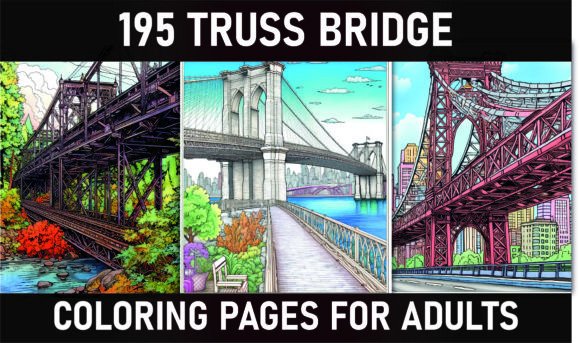
There’s a quiet confidence in a well-designed bridge—arched, grounded, connecting two points with purpose and grace. That same intentionality lives in the 195 Bridge Coloring Pages for KDP: not just line art, but thoughtfully composed illustrations that invite focus, rhythm, and presence. These aren’t generic silhouettes or clip-art derivatives. Each of the 195 pages features hand-crafted architectural detail—stone textures, ironwork filigree, suspension cables rendered with subtle weight, timber trusses with visible grain, and urban bridges layered with street-level context like benches, lampposts, and passing cyclists. The style balances realism and stylization: precise enough to satisfy detail-oriented colorists, open enough to welcome expressive interpretation.
This is monochrome design at its most functional and evocative. Rendered exclusively in crisp black-and-white at 300 DPI, every line holds clarity whether printed on matte paper or viewed on a tablet screen. The JPG and PNG files are production-ready—not placeholders, not upscaled, not traced from low-res sources. You’ll notice the intentional variation in line weight: heavier outlines anchor structural elements, while finer strokes suggest reflection, shadow, or distant foliage. That nuance matters when you’re building a coloring book people return to—not once, but across seasons and moods.
Why This Set Fits Real Publishing Workflows
If you’ve uploaded to Kindle Direct Publishing before, you know how quickly small inconsistencies derail a project—bleed errors, resolution warnings, cover mismatches. The 195 Bridge Coloring Pages for KDP was built inside those constraints. The 8.5 × 11 inch size aligns with KDP’s most forgiving interior specs. All 195 images are sized, spaced, and centered to avoid cropping surprises. Even the six cover options were tested against KDP’s spine calculator and thumbnail rendering—no crucial details vanish in preview mode.
But it’s more than technical compliance. These pages support *intentional* interior design. You’re not limited to one layout. With consistent margins, balanced negative space, and varied composition (some pages emphasize vertical span, others wide horizontals or tight close-ups), you can assemble at least five distinct interior themes: “Historic Bridges of Europe,” “Modern Infrastructure,” “Riverside & Coastal Crossings,” “Urban Bridges at Dusk,” and “Minimalist Arch Studies.” Each feels cohesive—not because they’re identical, but because they share a unified visual language: confident linework, architectural honesty, and breathing room.
Design Flexibility Beyond the Coloring Book
While built for KDP, these assets function powerfully outside the coloring niche. Designers use individual bridge illustrations as editorial graphics in architecture blogs or sustainability reports—pairing them with clean sans serif typefaces to reinforce credibility and calm authority. Marketers repurpose select pages as social media visuals for travel brands or civil engineering firms, adding subtle duotone overlays or animated parallax effects in Canva or Figma. Crafters print single pages onto cardstock for handmade greeting cards (“Crossing into a new chapter”) or frame them as minimalist wall art for offices and waiting rooms.
The black-and-white foundation makes color adaptation effortless. Need a warm sepia tone for a heritage tourism campaign? Apply a simple layer blend mode. Want high-contrast neon for a tech startup’s conference backdrop? Drop the image into a vector editor and recolor non-destructively. Because the files include both JPG (for fast previews) and PNG (with transparent backgrounds), you retain flexibility whether you’re building web banners, email headers, or packaging mockups.
What to Check Before You Build
Before assembling your first interior, take five minutes to scan three things:
- Line density: Some pages—like covered wooden bridges or lattice-truss designs—carry more fine detail. Test print one at 100% scale on your target paper stock. If lines blur or fill in, consider lightening the contrast slightly in your editing software.
- Subject balance: A few pages place the bridge off-center to imply movement or perspective. If your brand voice leans toward symmetry and stability, prioritize centered compositions—or pair asymmetrical ones intentionally with mirrored layouts on facing pages.
- Cover compatibility: The six included covers vary in tone—some emphasize texture, others typography space, one uses subtle gradient shading. Match your chosen cover’s energy to your interior’s pacing. A highly detailed cover pairs best with interiors that begin strong, then ease into quieter, more spacious pages.
You don’t need special software to succeed here. These files open cleanly in free tools like Photopea, GIMP, or even PowerPoint for basic resizing and arrangement. For KDP, export interiors as PDF/X-1a with embedded fonts (if adding text) and CMYK color profile—though since all artwork is grayscale, RGB is perfectly acceptable and keeps file sizes lean.
A Resource That Grows With Your Practice
What sets the 195 Bridge Coloring Pages for KDP apart isn’t just volume—it’s versatility rooted in craft. These aren’t algorithmically generated patterns. They reflect observation: how light falls across a steel arch at noon versus golden hour, how moss gathers in crevices of old masonry, how tension cables vibrate in wind. That authenticity translates into audience trust. People recognize care. They feel it in the smoothness of a coloring session—and they remember the creator who offered it.
Whether you’re launching your first KDP coloring book, developing a branded workshop series around infrastructure art, or sourcing unique visuals for a client’s annual report on sustainable development, this set delivers without overpromising. It doesn’t shout. It stands—solid, adaptable, and quietly refined—like the bridges it portrays.