220 Bicycle Flower Coloring Pages KDP: A Practical Guide for Adult Coloring Book Creators
For creators building coloring books for adults on Amazon KDP, the 220 Bicycle Flower Coloring Pages KDP bundle offers a focused, production-ready resource centered on two widely resonant themes: bicycles and botanicals. Unlike generic clipart packs or broad-themed collections, this set deliberately merges transportation motifs with floral intricacy—creating a cohesive aesthetic that appeals to niche but engaged audiences, including cycling enthusiasts, gardeners, eco-conscious adults, and fans of vintage-inspired line art.
What Makes This Bundle Distinct?
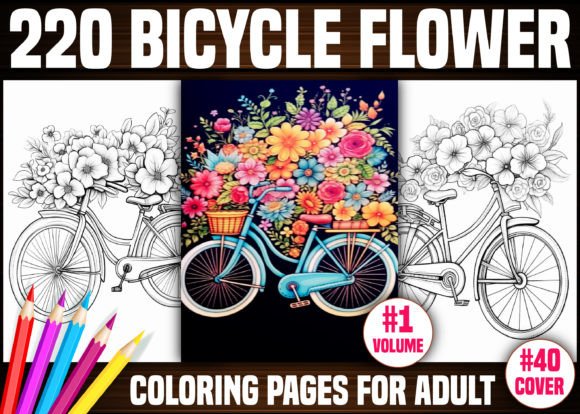
The 220 Bicycle Flower Coloring Pages KDP is not a random assortment of illustrations. It’s structured as a complete publishing asset: 220 original, hand-drawn (or digitally rendered with hand-crafted intent) interior pages, plus 40 cover designs in PNG format. All interiors are sized at 8.5 × 11 inches—standard for US letter-size coloring books—and delivered in both JPG and PNG formats at 300 DPI, ensuring crisp reproduction when printed. The black-and-white line work is consistently high-contrast and clean, avoiding thin or broken lines that often cause printing issues on KDP’s print-on-demand system.
Crucially, the bundle includes a single, ready-to-upload PDF containing all 220 interiors—formatted for immediate use in KDP’s interior upload workflow. This eliminates the need for manual page assembly, resizing, or DPI conversion, which many new publishers underestimate in terms of time and technical risk.
How It Compares With Other Approaches
Many creators start by sourcing free SVG files, using AI-generated images, or commissioning custom illustrations. Each has tradeoffs:
- Free or low-cost clipart: Often lacks thematic consistency, may have licensing restrictions for commercial use, and rarely meets KDP’s resolution or bleed requirements without editing.
- AI-generated coloring pages: Can produce novel combinations quickly, but frequently suffers from inconsistent line weight, anatomical inaccuracies (e.g., warped bicycle frames or botanically implausible flowers), and unpredictable copyright status—especially for commercial resale.
- Custom illustration commissions: Offers full creative control and uniqueness but carries higher cost ($300–$1,500+), longer timelines (weeks to months), and requires clear briefs and revision management.
In contrast, the 220 Bicycle Flower Coloring Pages KDP sits between those extremes: it’s affordable, immediately usable, and thematically unified—without requiring design expertise or legal vetting. It doesn’t replace custom work for brands seeking exclusive IP, but it does provide a reliable baseline for testing market response before investing in bespoke assets.
Strengths for Specific Use Cases
This bundle excels in scenarios where speed, thematic coherence, and platform readiness matter most:
- Rapid prototyping: You can compile, format, and publish a full 220-page coloring book on KDP within a day—ideal for validating demand around “bicycle + nature” aesthetics before expanding into related niches (e.g., “vintage bike cafes” or “botanical bike tours”).
- Series development: With 40 cover options included, you can launch multiple variations—different titles, subtitle angles (“for Stress Relief,” “with Inspirational Quotes,” “Large Print Edition”)—using the same interior pool. That reduces per-book design overhead significantly.
- Hybrid physical/digital offerings: Because all files are provided in both JPG and PNG (300 DPI), the same assets support print books, downloadable PDFs for Etsy or your own site, and even printable wall art bundles—without reformatting.
Tradeoffs and Limitations to Consider
No pre-made bundle is universally optimal. Key limitations of the 220 Bicycle Flower Coloring Pages KDP include:
- No editable source files: All illustrations are raster-based (JPG/PNG). You cannot adjust individual elements—like moving a flower petal or resizing a handlebar—in vector software. If your workflow depends on layered, scalable assets (e.g., for animation or responsive web use), this isn’t the right fit.
- Fixed theme scope: While “bicycle + flower” is distinctive, it’s narrower than broader categories like “mandalas” or “animals.” That limits cross-audience appeal but strengthens positioning for targeted marketing—especially via Pinterest, cycling blogs, or gardening newsletters.
- No text or typography: The pages contain only line art—no quotes, prompts, or background textures. If your brand relies on inspirational messaging or guided journaling elements, you’ll need to add those separately.
When It’s Likely the Right Choice
The 220 Bicycle Flower Coloring Pages KDP fits best when you prioritize:
- Time efficiency over total uniqueness: You want to publish quickly and learn from real sales data—not wait for custom art or troubleshoot AI artifacts.
- Niche alignment over mass appeal: Your ideal reader enjoys slow living, urban cycling culture, sustainable hobbies, or nostalgic design—making thematic cohesion more valuable than sheer variety.
- Platform-specific reliability: You’re publishing primarily through KDP and value files pre-validated for its requirements (bleed-free margins, CMYK-safe grayscale, correct DPI).
It also suits creators who already have a complementary skill—like writing calming prompts, designing covers, or running targeted ads—and want to focus energy there instead of illustration.
When You Might Choose Another Option
Consider alternatives if:
- You’re building a long-term brand and need fully exclusive, trademarkable artwork. In that case, commissioning original vector illustrations—even for a smaller initial set—is a better long-term investment.
- Your audience expects interactive or educational content (e.g., labeled plant parts, historical bike facts, or step-by-step drawing guides). The 220 Bicycle Flower Coloring Pages KDP contains no explanatory text or layered learning components.
- You’re targeting international markets where A4 sizing is standard. While 8.5 × 11″ files can be resized, doing so risks subtle distortion or loss of fine detail—especially in dense floral sections.
Realistic Examples in Practice
A creator in Portland used the 220 Bicycle Flower Coloring Pages KDP to launch Bloom & Pedal: A Pacific Northwest Coloring Journal. They selected 20 covers with Pacific Northwest flora (e.g., Douglas fir sprigs, Oregon grape), added locally inspired backmatter (a short essay on bike-friendly gardens), and published three variants in one week. Sales were modest but consistent—enough to justify commissioning 30 additional custom pages for Volume 2.
Conversely, a UK-based educator wanted to create a classroom resource pairing bike safety with plant biology. Though the bundle’s illustrations were charming, they lacked the labeling space and scientific accuracy needed—so she opted for a hybrid approach: using 50 pages from the bundle for relaxation segments, and commissioning 50 custom diagrams for the curriculum-aligned portion.
Making an Informed Decision
Choosing resources like the 220 Bicycle Flower Coloring Pages KDP isn’t about finding the “best” option—it’s about matching tools to goals, constraints, and audience expectations. Ask yourself:
- What’s my primary bottleneck—time, budget, technical skill, or creative bandwidth?
- Do I need maximum flexibility—or maximum speed-to-market?
- Will readers value thematic depth more than stylistic variety?
- Am I testing a concept, supporting an existing brand, or building a library long-term?
Answering those honestly helps clarify whether this bundle serves as a foundation, a supplement, or simply a useful reference point among other viable paths forward.