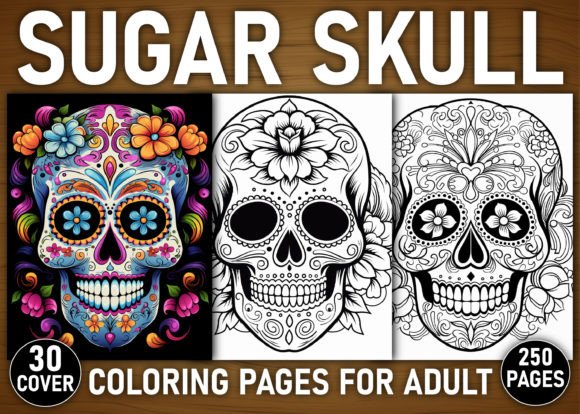
250 Sugar Skull Coloring Pages for KDP
For creators, designers, and self-publishing entrepreneurs building coloring book collections on Amazon KDP, 250 Sugar Skull Coloring Pages for KDP is a purpose-built asset pack—not just another generic set of illustrations. It’s designed with platform-specific technical requirements in mind: bleed-ready A4 (8.5 × 11 inch) layouts, print-optimized line weights, consistent negative space for coloring comfort, and file formats aligned with KDP’s upload standards. Unlike broad-themed adult coloring packs that scatter motifs across cultures or seasons, this collection maintains tight visual cohesion—centered exclusively on sugar skull iconography reimagined through 250 distinct compositions.
What Sets This Collection Apart From General Adult Coloring Resources
Most adult coloring page bundles prioritize volume over function: 500+ pages across florals, mandalas, animals, and abstracts—but with inconsistent line density, uneven margins, or missing bleed. 250 Sugar Skull Coloring Pages for KDP avoids that fragmentation. Every illustration is crafted to support two practical outcomes: clean single-page printing and scalable reuse across multiple book volumes. The line art balances intricacy and accessibility—detailed enough for experienced colorists, yet legible at standard print resolution without pixelation or unintended gaps.
The inclusion of three complementary file types—PDF (for direct KDP interior uploads), JPG (for quick previews or mockups), and PNG (with transparent backgrounds for editing)—adds flexibility most general-purpose packs lack. PNG files, in particular, let users isolate elements, adjust contrast, or integrate skulls into custom cover composites without wrestling with clipping masks or background removal tools.
How It Compares With Other Sugar Skull–Themed Options
Some illustrators release sugar skull sets as standalone digital downloads with only one format—often low-res JPGs unsuitable for print—or bundle them within broader “Mexican Folk Art” collections where skulls share space with alebrijes, papel picado patterns, or Day of the Dead altars. While those offer cultural breadth, they dilute thematic focus and reduce usability for targeted KDP listings. In contrast, 250 Sugar Skull Coloring Pages for KDP delivers depth over breadth: variations include ornamental flourishes (feathers, marigolds, geometric filigree), stylistic shifts (Art Deco symmetry, neo-traditional linework, minimalist silhouettes), and compositional diversity (full-face portraits, profile studies, stacked arrangements, border frames).
Volume matters—but so does curation. A set of 300 loosely related skulls may include repeats with minor rotations or mirrored flips. This package avoids that redundancy. Each of the 250 pages is individually composed, verified for uniqueness, and tested for coloring flow—ensuring no awkward dead ends, trapped white zones, or overly dense clusters that frustrate fine-tip pens or gel markers.
Practical Fit: When This Is the Right Choice
This resource fits best when your goal is efficiency, consistency, and compliance—not experimentation. If you’re launching a niche KDP series (e.g., “Sugar Skull Serenity,” “Dia de los Muertos Calm,” or bilingual editions with Spanish titles), having 250 ready-to-upload interiors saves dozens of hours on layout, resizing, and bleed adjustment. It also supports rapid iteration: publish Volume 1, gather early reviews, then release Volume 2 using the companion set—250 Sugar Skull Coloring Pages for Adult Vol-2—which extends the library without overlapping designs.
It’s especially useful if you lack illustration skills or prefer licensing pre-vetted assets over commissioning custom work. Commissioning 250 original sugar skull illustrations would typically cost $3,000–$7,000+ depending on artist rates and usage rights. Licensing this pack represents a predictable, upfront investment with commercial redistribution rights included—no per-book royalties or attribution clauses.
Tradeoffs and Considerations
There are limitations worth acknowledging. Because the artwork is pre-made, you cannot request stylistic revisions—no swapping floral motifs for butterflies, no adjusting skull proportions, no adding personalized text or quotes. If your brand relies on highly specific visual language (e.g., watercolor textures, hand-lettered captions, or signature brushwork), this pack won’t accommodate that level of customization without significant post-production effort.
Also, while the 30 premium cover images provide strong starting points, they’re not fully branded templates. You’ll still need to add title typography, subtitle hierarchy, author name placement, and KDP-mandated barcode spacing. Designers comfortable with Canva or Affinity Publisher will find integration seamless; beginners may need basic layout guidance to avoid cropping critical elements during KDP’s auto-trim process.
File Structure and Technical Readiness
The package organizes assets for real-world workflow—not theoretical idealism. PDFs are single-page, non-password-protected, CMYK-ready (though RGB is acceptable for KDP’s conversion), and include 0.125-inch bleed on all sides. JPGs are saved at 300 DPI, sRGB color profile, and named sequentially (Skull_001.jpg through Skull_250.jpg) for batch import into design software. PNGs retain transparency and are sized identically to their PDF counterparts—making them ideal for layering over textured backgrounds or combining with other KDP-approved assets like decorative borders or corner flourishes.
This level of technical preparation reduces common KDP rejection reasons: blurry lines, missing bleed, incorrect dimensions, or embedded fonts. That reliability matters when you’re managing multiple live titles and can’t afford delays from formatting errors.
Who Benefits Most—and Who Might Look Elsewhere
This pack serves creators who value time, scalability, and thematic precision. Indie publishers releasing seasonal or holiday-aligned books (e.g., October releases tied to Día de los Muertos) benefit from having a complete, culturally resonant interior set without waiting for illustration turnarounds. Print-on-demand sellers bundling physical + digital versions appreciate the dual-format delivery—PDF for print, JPG/PNG for web previews or social media teasers.
Conversely, educators developing classroom materials, therapists creating clinical coloring tools, or artists seeking editable vector files (SVG/EPS) would likely need alternatives. This collection delivers raster-based assets only—excellent for print but not suited for infinite scaling or path-based editing. Similarly, if your audience prefers looser, sketch-style line art or expressive, imperfect linework (rather than clean, controlled outlines), this may feel too polished or rigid.
Realistic Use Cases Beyond KDP
While built for KDP, the files support broader applications. Therapists use individual pages as session handouts—printing select skulls based on client themes (grief, remembrance, transformation). Designers license pages for merchandise: mugs, tote bags, or greeting cards—leveraging the high-res PNGs for crisp transfers. Educators incorporate them into cultural studies units, pairing pages with historical context about Mesoamerican symbolism, colonial syncretism, or contemporary Mexican art movements.
Even hobbyists benefit: the A4 sizing works seamlessly with home printers, and the variety prevents repetition fatigue across weeks or months of coloring practice. Unlike mass-market coloring books with duplicated spreads, this collection ensures each session introduces a new configuration—supporting sustained engagement without burnout.
Making an Informed Decision
Choosing 250 Sugar Skull Coloring Pages for KDP isn’t about finding the “best” coloring resource—it’s about matching capabilities to goals. Ask yourself: Do I need speed and consistency over bespoke design? Am I focused on a narrow theme rather than eclectic variety? Do I require files that meet KDP’s technical bar without troubleshooting? If yes, this pack answers those needs directly. If your priorities lean toward customization, vector flexibility, or cross-platform adaptability (e.g., interactive PDFs or app integration), then evaluating SVG libraries, illustrator collaborations, or multi-format subscription services may be more appropriate.
Ultimately, its strength lies in execution—not novelty. It doesn’t try to reinvent sugar skull art. Instead, it delivers 250 thoughtfully rendered, technically sound, commercially usable interpretations—each one built to help creators ship confidently, scale sustainably, and serve audiences who seek both beauty and intention in every line.