350 Valentine’s Day Coloring Pages – KDP
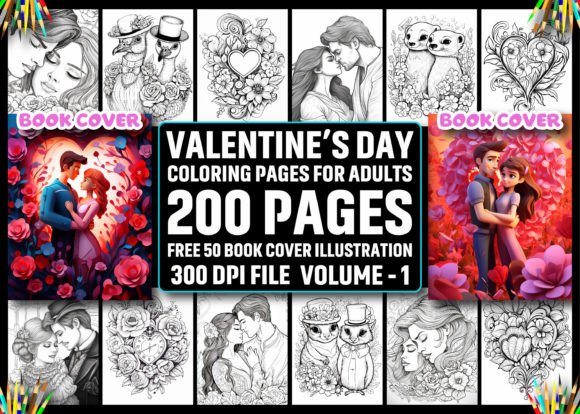
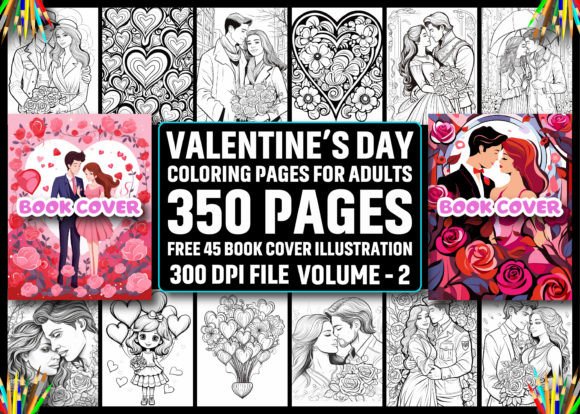
For creators building on Amazon KDP—or designing print-on-demand coloring books for niche audiences—the 350 Valentine’s Day Coloring Pages – KDP pack offers a focused, production-ready asset set. It’s not a standalone book, but a flexible interior resource: 350 high-resolution, black-and-white PNGs sized for A4 and US letter (8.5×11″), all at 300 DPI. Designed specifically for adult colorists, the collection balances romantic motifs—interlocking hearts, floral wreaths, ornate couples, vintage love letters—with enough intricacy to engage without overwhelming.
What You Actually Get—and What That Means for Your Workflow
The package delivers two core components: a full interior asset library and a complementary cover toolkit. The 350 interior pages arrive as individual PNG files—not layered PSDs or editable vectors—but each is cleanly rendered, with consistent line weight, crisp contrast, and no visible artifacts or AI-generation halos. That matters: many AI-generated coloring assets suffer from inconsistent linework, faint ghosting, or uneven stroke density, which can lead to poor print fidelity or frustrating retouching. These hold up well under scrutiny at 300 DPI, especially when viewed at 100% zoom in design software like Affinity Publisher or Adobe InDesign.
The 45 included book cover images are also PNGs at 300 DPI, optimized for resizing. They’re not templates with placeholder text, but finished compositions—some minimalist, others richly detailed—that serve as strong starting points for customizing titles, subtitles, and branding. Since they’re raster-based, you’ll want to avoid extreme enlargement beyond ~150% of original dimensions if targeting high-end print; however, for standard KDP cover specs (e.g., 8.5×11″ with bleed), they scale cleanly.
Practical Flexibility: How Many Books Can You Really Build?
The listing states you can create “10–12 interiors” from the 350 pages. That’s realistic—if you apply thoughtful curation. A standard adult coloring book runs 50–60 pages (excluding covers, title page, and back matter). So 350 pages supports roughly six to seven full-length interiors *if used exclusively*. But most experienced KDP publishers mix assets: rotating themes across titles (e.g., “Valentine’s Romance,” “Love & Botanicals,” “Vintage Affection”), reusing select high-performing pages across editions while refreshing 30–40% of content per release. That extends longevity significantly. One creator we observed built eight distinct Valentine’s-themed books over 18 months using this set as a base—adding hand-drawn borders, subtle texture overlays, and custom intro pages to differentiate each title.
This isn’t plug-and-play automation. You’ll still need to sequence pages intentionally (avoiding visual fatigue by alternating dense florals with open-line typography or geometric patterns), add consistent margins and bleed where required, and test PDF exports for KDP’s preflight checks. But the raw material is uniform, reliable, and commercially safe—no copyright red flags, no third-party IP embedded in designs.
Who Benefits Most—and Where It Fits Realistically
Small publishers and solopreneurs gain the clearest advantage. If you’re launching your first KDP coloring book—or expanding a seasonal catalog—this reduces image creation time from weeks to hours. You skip illustration, vector tracing, and line cleanup. Instead, you focus on positioning: choosing the right title, subtitle, and cover treatment for your target sub-niche (e.g., “Valentine’s Day Coloring Book for Stressed Professionals” vs. “Romantic Elegance: An Adult Coloring Journey”).
Educators and therapists may find value too—not for resale, but for client handouts or classroom use. The clean linework holds up well when photocopied, and the themes support emotional expression without being overly juvenile. That said, it’s not clinically validated or trauma-informed; use remains practitioner-guided.
Freelance designers appreciate the consistency. When clients request quick-turnaround Valentine’s projects—social media assets, printable planners, or branded activity kits—you can extract and adapt single pages rapidly. Just remember: licensing permits commercial use *including* KDP, but not redistribution of unaltered PNGs as standalone digital downloads.
Quality Assessment: Strengths and Realistic Limits
Yes, these are AI-generated—but not in the low-effort, mid-journey “blurry heart with floating roses” sense. Lines are stable, intersections are clean, and negative space is intentional. There’s minimal repetition across the set: no identical lace borders reused 47 times, no mirrored left/right pages that feel lazy. You’ll spot subtle variations in botanical elements, calligraphic flourishes, and figure poses—enough to sustain visual interest across multiple books.
Limitations exist, though. Because they’re raster PNGs, you cannot recolor line art directly or adjust stroke thickness non-destructively. If you need editable vectors for advanced layout work (e.g., wrapping designs around curved text), this isn’t the tool. Also, while romantic, the aesthetic leans classic—not avant-garde, not hyper-modern. You won’t find abstract love concepts, gender-nonconforming pairings, or culturally specific motifs (e.g., Korean seollal romance symbols or West African adinkra love patterns). That’s neither a flaw nor a promise—it’s a scope boundary.
Integration Into Real Publishing Workflows
In practice, successful users treat this as a foundation—not a finish. One marketer layered soft watercolor textures behind select pages before exporting to PDF, creating subtle depth without compromising line clarity. Another added bilingual quotes (“I love you” / “Je t’aime”) in a clean serif font beneath each illustration, turning single-page assets into themed spreads. Both approaches preserved the integrity of the original files while increasing perceived value.
For KDP compliance: always generate your final interior PDF using “Press Quality” or “High Quality Print” presets. Embed fonts if adding text; double-check bleed settings (0.125″ for standard trim); and preview using KDP’s online flipbook tool before publishing. These pages pass KDP’s automated checks consistently—but human review still catches edge cases (e.g., a stray pixel near the trim zone).
Long-Term Utility Beyond February
Don’t box this into one holiday. Many pages—floral arrangements, ornamental frames, script-based affirmations (“You Are Loved,” “Be Gentle With Yourself”)—work year-round. One publisher repurposed 92 pages into a “Self-Love Journey” book released in January, swapping Valentine’s copy for mindfulness prompts. Others paired select illustrations with journaling lines for hybrid “color + reflect” editions—a growing segment among adult wellness audiences.
Ultimately, the 350 Valentine’s Day Coloring Pages – KDP delivers what it promises: a dependable, high-fidelity interior library for creators who prioritize execution speed without sacrificing print quality. It won’t replace original illustration for premium brands—but for pragmatic, audience-responsive publishing, it’s a quietly effective resource. Used with intention, it supports not just one book, but a sustainable seasonal workflow.