Cute Axolotl Coloring Pages for Kids KDP
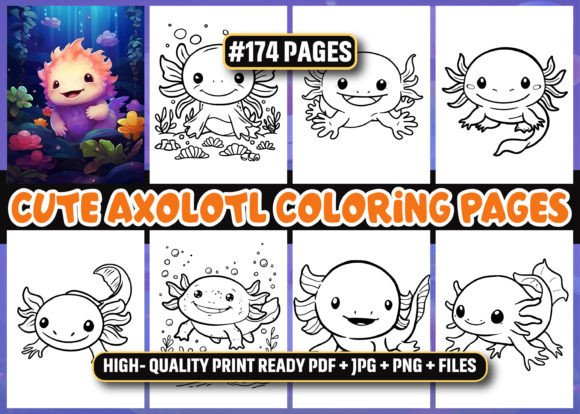
For creators building coloring book businesses on Amazon KDP—or educators, designers, and small publishers seeking ready-to-use, high-quality interior assets—Cute Axolotl Coloring Pages for Kids KDP delivers a focused, production-ready solution. This isn’t just another generic bundle: it’s a thoughtfully compiled set of 174 original black-and-white axolotl illustrations, optimized specifically for print-on-demand workflows, classroom use, or digital distribution.
Why Axolotls? And Why Now?
Axolotls have surged in popularity—not just as internet icons but as gentle, expressive subjects ideal for children’s creative engagement. Their wide-eyed charm, frilly gills, and playful poses translate exceptionally well into line art that’s both inviting and age-appropriate. Unlike more complex animals, axolotls offer clean contours and consistent proportions, making them forgiving for young colorists while still offering enough visual interest to hold attention across repeated use. That practicality matters when you’re designing for real-world application—not just aesthetics.
What You Actually Get—and What It Solves
The bundle includes 174 unique interior pages in three formats: PDF (print-ready A4 and US Letter), JPG, and PNG—all at 300 DPI. That means no last-minute resizing, no pixelation when scaling for covers or social media previews, and no compatibility hiccups with KDP’s upload system. Each page is sized to standard coloring book dimensions (8.5″ × 11″), so interiors align seamlessly with Amazon’s KDP requirements without manual cropping or reformatting.
Beyond interiors, the package includes 98 premium book cover illustrations in PNG format—also at 300 DPI. These aren’t stock templates. They’re custom-designed, axolotl-centric visuals with balanced negative space, clear typography zones, and intentional layout margins—making them ideal starting points for KDP cover creation. You can resize them confidently, layer text, or adapt them for different age brackets (e.g., “Axolotl Friends” for ages 4–7 vs. “Axolotl Adventures” for 8–12) without losing fidelity.
Real-World Use Cases That Save Time and Reduce Risk
A freelance designer launching their first KDP coloring book can go from download to live listing in under two hours—using the PDF interiors directly and selecting a cover image from the 98 options. No illustration commissions. No licensing concerns. No waiting for revisions.
For educators or after-school program coordinators, the JPG and PNG files integrate smoothly into lesson plans: import into Canva for custom worksheets, embed in Google Slides for interactive coloring sessions, or print single pages for quiet-time activities. The consistent 300 DPI resolution ensures crisp output whether printed on a school laser printer or projected onto a smartboard.
Small publishers building themed series (e.g., “Cute Creature Coloring Collection”) benefit from visual continuity—the 174 axolotl pages share a cohesive artistic voice (Victor illustration style), so they read as a unified product rather than a patchwork of outsourced assets. That consistency builds brand trust and improves repeat purchase likelihood.
Commercial Flexibility Without Hidden Limits
This is licensed for personal, educational, and commercial use—including unlimited resale on Amazon KDP, Etsy, or your own website. There are no per-unit fees, no attribution requirements, and no restrictions on bundling (e.g., pairing axolotl pages with matching mazes or tracing sheets you create). You retain full rights to market, brand, and price the final product as you see fit.
That flexibility matters most when scaling. If one axolotl-themed book gains traction, you can quickly launch companion titles—“Axolotl Mazes,” “Axolotl Dot-to-Dot,” or bilingual editions—using the same core illustrations as visual anchors. The 98 cover images support this too: they’re diverse enough to suggest different sub-themes (underwater scenes, party hats, nature backgrounds) without requiring new artwork.
Practical Considerations Before You Begin
While the bundle excels for KDP-focused creators, it’s not a design course or marketing toolkit. You’ll still need to handle title selection, description writing, keyword research, and category placement—tasks where understanding Amazon’s algorithm remains essential. Likewise, if your audience prefers highly detailed, intricate designs for older kids or adults, these pages skew toward simplicity and accessibility (ages 3–10), not advanced complexity.
The illustrations are intentionally black-and-white line art—no grayscale shading or textured fills. That’s ideal for young children and standard coloring book expectations, but less suited for markets seeking “art therapy” or “stress-relief” positioning. Also, while all files are 300 DPI, the PNGs include transparent backgrounds—a plus for custom layouts—but require basic familiarity with layering tools (e.g., Photoshop, Affinity Designer, or even Canva Pro) to use effectively.
Who Benefits Most—and Why
First-time KDP publishers gain immediate access to professionally rendered interiors and covers—reducing startup friction and eliminating common formatting rejections. Educators and homeschoolers get classroom-ready, copyright-safe material that supports fine motor development and thematic learning (e.g., amphibians, life cycles, biodiversity). Freelance designers can offer clients fully branded coloring books without multi-week illustration timelines. And small studios building niche product lines find a reliable, scalable asset base—especially valuable when targeting emerging trends like “cute biology” or “STEM-themed creativity.”
How to Maximize Value Long-Term
Start by auditing the 174 pages for natural groupings: underwater scenes, axolotls with accessories (hats, glasses, instruments), action poses (swimming, waving, sleeping), and themed variants (holiday, birthday, science lab). This helps structure your KDP book logically—and informs future spin-offs. Use the 98 cover images not just as front matter, but as inspiration for back-cover blurbs, interior thumbnails, or even printable reward certificates.
Because the files are delivered in ZIP format with clearly named folders (e.g., “Interiors_PDF”, “Covers_PNG”), file management stays intuitive—even as your library grows. And since all formats are included, you’re never locked into one workflow: use PDFs for direct KDP uploads, JPGs for quick social media teasers, and PNGs for layered branding experiments.
In short, Cute Axolotl Coloring Pages for Kids KDP works best when treated as a foundational production asset—not just content to resell, but infrastructure to build upon. Its strength lies in reliability, specificity, and readiness: no guesswork, no gaps, no wasted time chasing permissions or troubleshooting resolution issues. For anyone turning creative ideas into tangible products, that kind of clarity is rare—and genuinely useful.