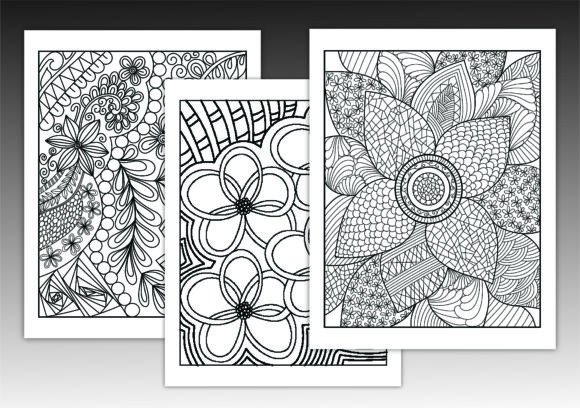
Relaxing Adult Coloring Page for Kdp
If you’ve ever scrolled through Amazon KDP looking for a low-risk, high-margin digital product that doesn’t require inventory, shipping, or customer service—and yet delivers real value to buyers—you’ve likely paused on adult coloring books. But not all coloring pages are built the same. A Relaxing Adult Coloring Page for Kdp isn’t just another black-and-white outline—it’s a thoughtfully crafted Zen coloring sheet designed to serve dual purposes: as a therapeutic tool for end users *and* a versatile, scalable asset for creators.
This particular set centers around Zentangle-inspired patterns—structured, repetitive, meditative line work that guides focus without demanding artistic skill. Each page is drawn in crisp vector format using Adobe Illustrator, meaning it scales flawlessly from thumbnail previews to full A4 (8.5″ x 11″) printouts. The interior files come as both editable .AI layers and high-resolution PNGs—zipped together for immediate use—so whether you’re bundling them into a themed workbook or inserting them into a mindfulness course PDF, they hold up under resizing, cropping, or layout adjustments.
Where and when people actually reach for these pages
Think about your own week. You open your laptop at 7 a.m. to answer emails, then spend three hours in back-to-back Zoom calls. By 3 p.m., your eyes feel gritty, your shoulders are tight, and your brain has hit “buffering.” That’s exactly when a Relaxing Adult Coloring Page for Kdp becomes more than decoration—it becomes a 10-minute reset button. No app download. No subscription. Just print, grab a pencil, and let your hand move while your mind unspools.
It’s the same reason educators print them before class: a quiet, tactile transition activity for students returning from recess or settling after lunch. Or why therapists keep a stack in their waiting rooms—not as filler, but as a nonverbal grounding exercise for clients who arrive anxious or overwhelmed. Even freelance designers use them during creative blocks—not to “make art,” but to shift mental gears by engaging fine motor control and rhythmic repetition.
Real use cases across different roles
For KDP publishers: You don’t need to build a 100-page book from scratch. This Relaxing Adult Coloring Page for Kdp gives you a polished, professional-grade interior sheet you can drop into any theme—“Zen Garden Doodles,” “Mindful Moments for Busy Professionals,” or “Stress Relief for Nurses.” Because it’s A4-sized and print-ready, it integrates cleanly with standard KDP templates. And since the AI file is layered and labeled, swapping borders, adding subtle watermarks, or adjusting spacing takes minutes—not hours.
For bloggers and course creators: Imagine offering a free “Zentangle Break” PDF download as a lead magnet. One page—clean, calming, instantly usable—builds trust faster than five paragraphs of advice. Later, you bundle six variations into a paid mini-guide (“6 Zen Patterns to Rewire Your Focus”) and sell it via Gumroad or Teachable. No illustration skills required. Just smart curation and context.
For small business owners: A local yoga studio adds one of these sheets to their post-class email newsletter—paired with a 90-second voice note on breath-synced coloring. A café prints them on recycled paper and leaves them at tables with colored pencils. It’s low-cost branding that feels personal, not promotional.
For educators and counselors: These aren’t “just for fun.” Research shows structured doodling improves attention regulation and reduces cortisol levels. That makes a Relaxing Adult Coloring Page for Kdp a practical classroom tool—not for art class, but for social-emotional learning blocks, IEP accommodations, or even staff wellness workshops.
What to consider before using or selling these pages
First: Know your audience’s intent. Someone buying a “stress relief” coloring book isn’t shopping for complexity—they want clarity, flow, and ease of entry. That’s why these Zentangle-style pages avoid overcrowded motifs or tiny, fussy details. Lines are consistent in weight, spacing is generous, and negative space is intentional—not an afterthought. If you’re bundling them, match that energy: pair them with gentle prompts (“Trace slowly. Breathe in for four lines, out for four.”), not rigid instructions.
Second: Check technical compatibility. While the PNGs work everywhere, the Illustrator file assumes basic familiarity with layers, grouping, and export settings. If you’re new to AI, spend 20 minutes watching a short tutorial on how to hide/show layers or adjust stroke width—those small edits make the difference between a generic page and one that feels custom-built for your brand.
Third: Respect usage boundaries. These files are licensed for commercial use on KDP and similar platforms—but not for resale as standalone digital assets (e.g., uploading the raw .AI file to Creative Market). They’re meant to be *part of something else*: a book, a course, a workshop kit. That limitation is actually a strength—it keeps your offer differentiated and values-added, not commoditized.
Why resolution and format matter more than you think
You might wonder why “high-resolution” and “vector-based” are emphasized so heavily. Here’s the reality: a blurry or pixelated scan gets deleted before it’s printed. A raster-only file distorts when enlarged for wall posters or shrinks into mobile app thumbnails. But because this Relaxing Adult Coloring Page for Kdp starts in Illustrator, you can generate clean 300 DPI CMYK PDFs for KDP, RGB PNGs for web previews, and even SVG versions for interactive web coloring tools—all from the same source.
That flexibility pays off quietly. When a buyer prints the page at home and the lines stay razor-sharp—even on budget printer paper—it builds credibility. When your KDP preview thumbnail looks crisp on a phone screen, it lifts click-through rates. When you later expand into planners or journal inserts, you’re not starting over—you’re reusing, rotating, and remixing what’s already proven.
At its core, a Relaxing Adult Coloring Page for Kdp is more than ink on paper. It’s a pause button built into a product. A bridge between intention and action. A small, repeatable act of care—whether you’re the person holding the pencil or the person putting the page into someone else’s hands.